Research

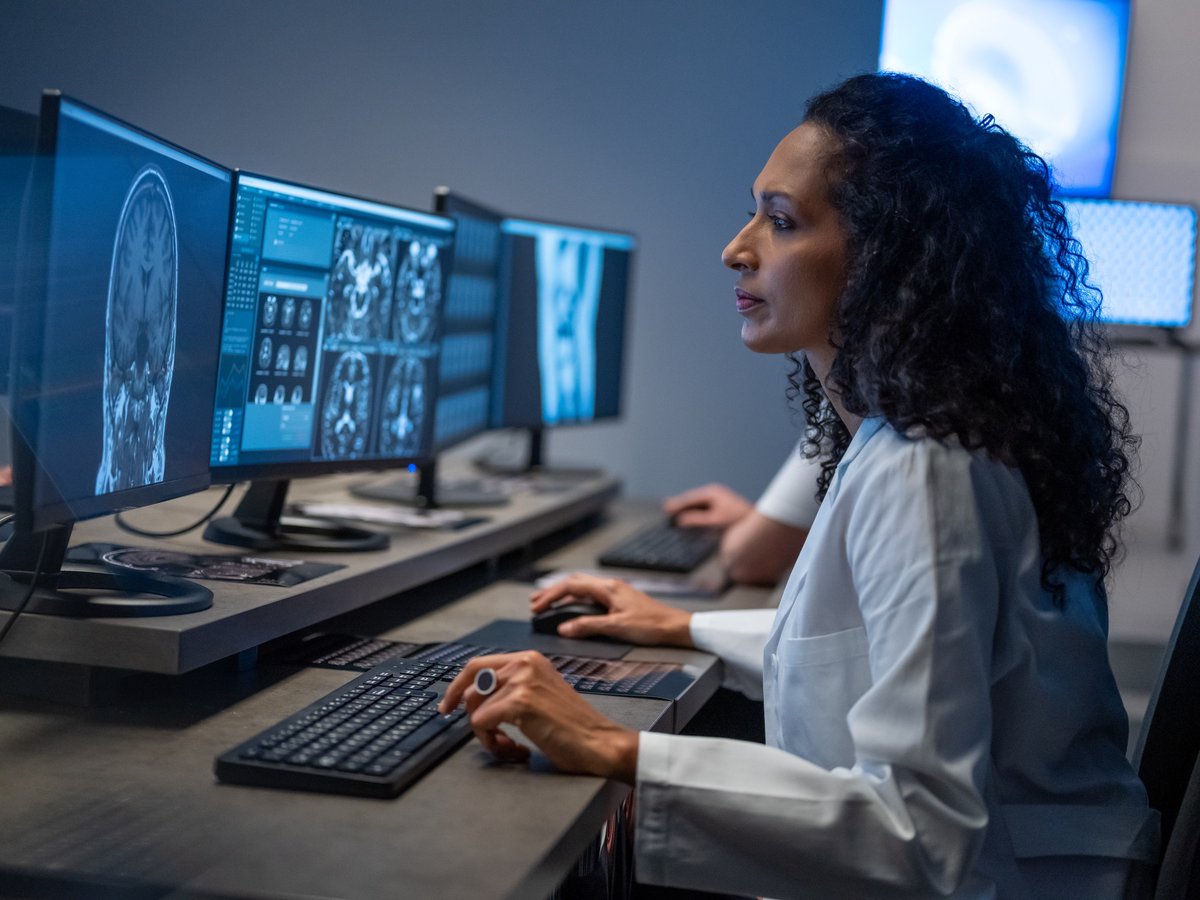
A radiologist reading brain and spine scans across a row of monitors

01

Jiazhen Pan · Julian Suk · Paula A. Perez-Toro · Philip Müller

AI for biomedical image analysis and interpretation

Medical imaging allows doctors to examine the interior structure or function of the human body, often without the need for invasive surgical procedures. It comprises a range of different techniques, such as computed tomography (CT), magnetic resonance imaging (MR) and ultrasound (US). Clinicians rely on the information provided by medical imaging to monitor patients, diagnose illnesses and decide on treatment.

Our mission is to support doctors in the clinical process and improve patient care by developing advanced algorithms that use artificial intelligence (AI) techniques. To this end, we create and improve machine learning (ML) algorithms for various parts of the medical imaging pipeline. At the image level, we develop methods to tackle tasks such as segmentation of relevant anatomical structures, registration of images across time or modalities, and enhancement of image quality. At the decision level, we innovate solutions to extract clinically useful information from medical images, diagnose diseases and predict future outcomes.

Developing these algorithms in the medical domain presents many challenges which we are striving to overcome. Medical data is often sparse and annotations for algorithm training are costly to acquire, with problems such as domain shift plaguing the few available data, which could be detrimental to ML algorithms. For this, we are developing data-efficient and domain-robust solutions, as well as exploring opportunities provided by the increasing availability of large public datasets / biobanks. Medical images are usually accompanied by additional information from different sources such as doctor’s notes, laboratory test results or genomics data, all of which should be considered when interpreting the images. Part of our research centers on developing multi-modal AI solutions that integrate these diverse data sources. Finally, to successfully deploy these algorithms in a hospital setting, we work in close collaboration with medical professionals to align our research with clinical value and to improve the interpretability of our ML algorithms to foster trust and facilitate adoption.
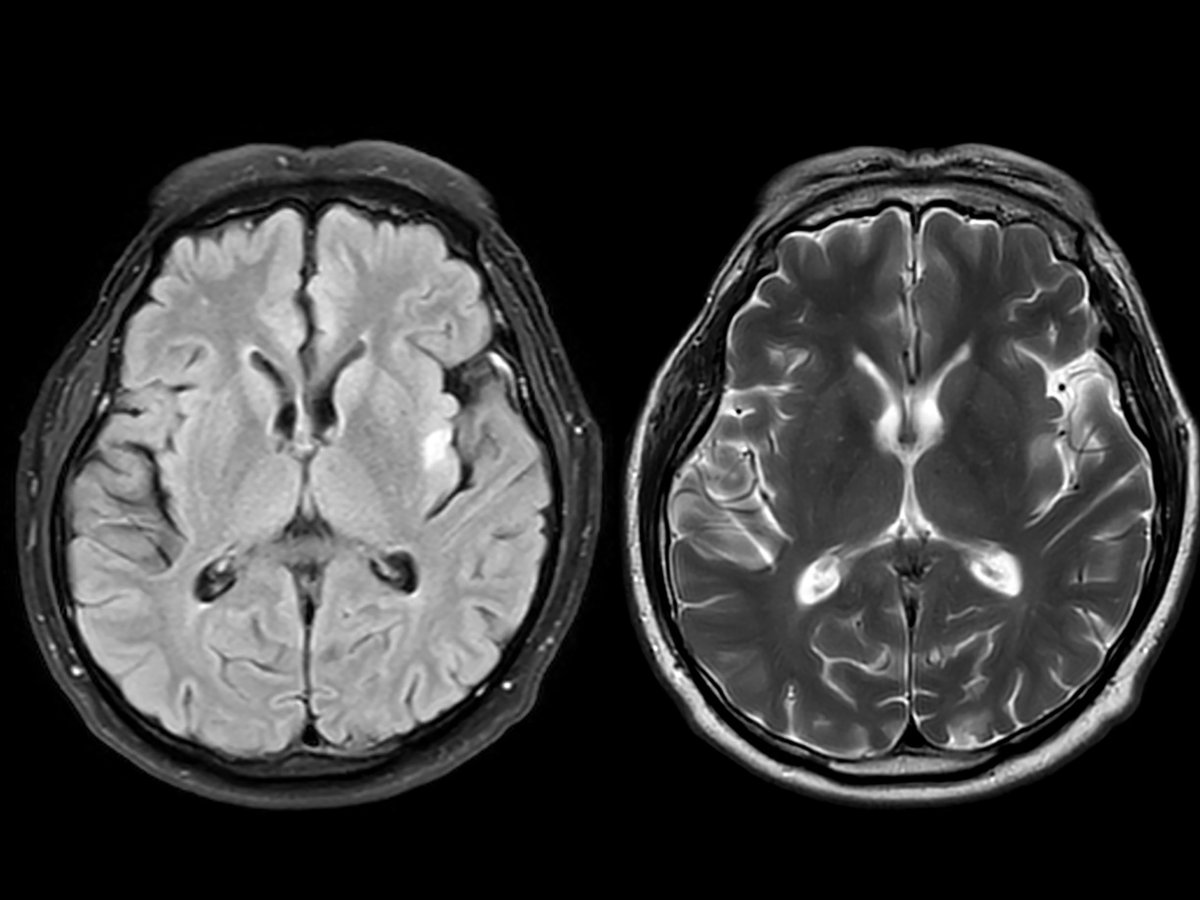
Two axial brain MRI slices, FLAIR and T2-weighted

02

Ivan Ezhov · Sevgi Gokce Kafali

Inverse problems in biomedical imaging

Our group is working on inverse problems in biomedical imaging and their solution using artificial intelligence and machine learning.

The development of algorithms to solve inverse problems arising in sensor and imaging systems has a long tradition. Examples include compressed sensing approaches, e.g. for medical and computational imaging. Until recently, most algorithms for inverse problems were based on statistical or physical signal models, such as wavelets or sparse representations. Our research focuses on novel approaches based on deep learning to accelerate solving such problems.

We study how these deep learning-based approaches can be optimized for clinical applications and how they can be combined with image analysis methods. Deep learning-based approaches for reconstructing magnetic resonance imaging (MRI) or computed tomography (CT) provide efficient AI models, allowing the reconstruction of high-quality MRI images, and high-quality CT images from low-dose X-ray images. Recent works on generative models have shown great promise for accelerating reconstruction tasks to shorten the scan time in MRI, as well as generating images with much higher resolution than the acquired resolution (e.g. super-resolution). Here, we tackle these problems by utilizing AI (i.e., diffusion models) guided by readily available MR images from other organs/tissues, MRI scanning parameters, or other MRI physics-guided information.

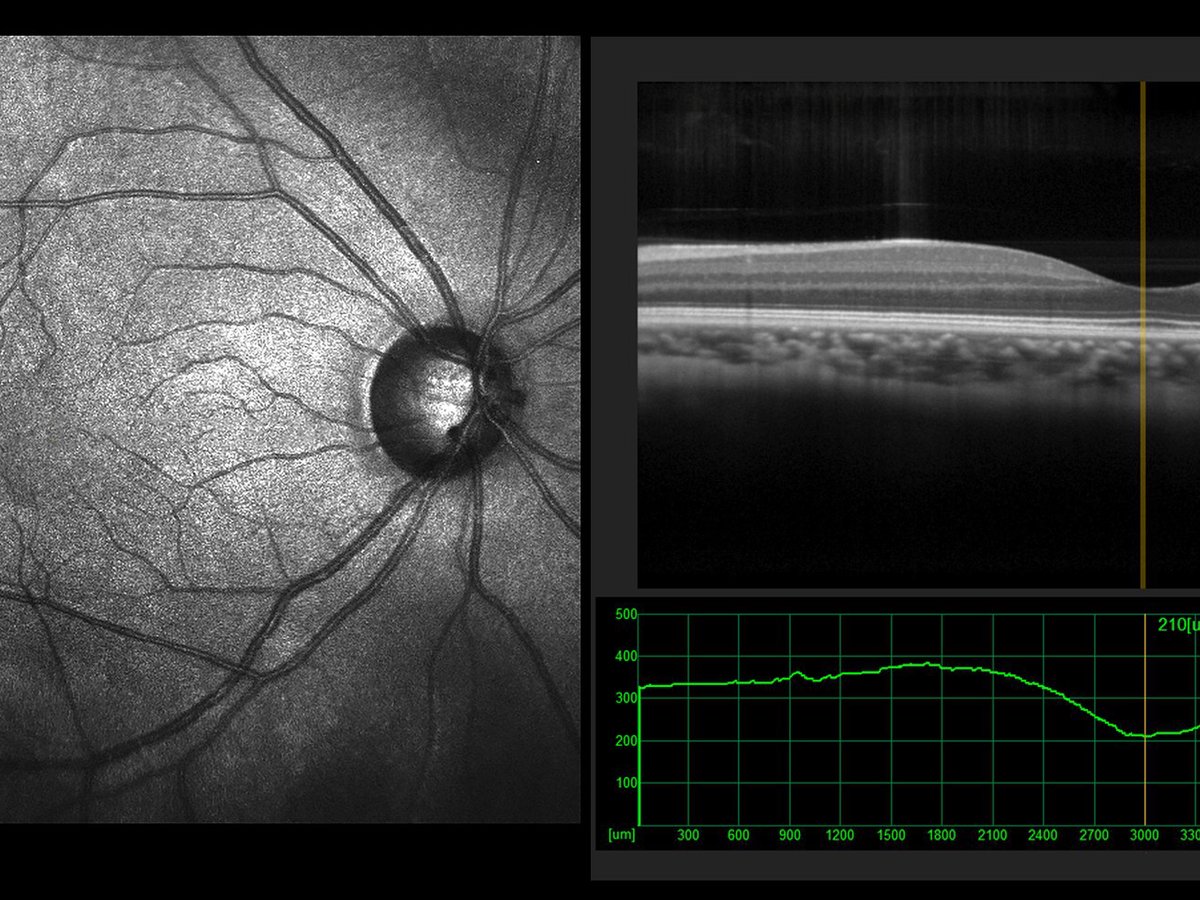
A retinal fundus image beside an OCT scan and its thickness profile

03

Martin Menten

AI for vision

The AI for Vision group focuses on blue-sky research in medical image analysis with a particular focus on the application of machine learning and computer vision algorithms in the field of ophthalmology. Specifically, we are working on:

Self-supervised learning. Labeling medical data is very expensive, as it is time-consuming and requires expert knowledge. Moreover, medical data often includes highly sensitive information, making it challenging to share without compromising the privacy of the subjects involved. To overcome the limited availability of large annotated medical datasets, we are researching self-supervised learning, leveraging unlabeled medical data to enable neural networks to extract meaningful features that can be effectively adapted to a wide range of downstream tasks.

Multimodal deep learning. Clinicians rarely rely on a single source of information when diagnosing patients and deciding on a course of action. They consider an array of multimodal data, such as demographic and genomic information, patient interviews, laboratory test results and biomedical images. Our research focuses on developing deep learning algorithms capable of integrating diverse multimodal data to support autonomous and effective clinical decision making.

Deep learning for ophthalmology. Good vision is essential for navigating our environment, communicating, and performing everyday activities. As of 2020, more than 200 million people worldwide suffered from moderate to severe vision impairment. Driven by the comparative ease of imaging the eye and obtaining large imaging datasets, ophthalmology has been an early adopter of deep learning in healthcare. Our group’s work in machine learning for ophthalmology simultaneously evaluates new algorithmic innovations while aiming to improve medical care for patients affected by ocular diseases.

A padlock on a shelf of patient files

04

Alexander Ziller · Raphael Rehms

Privacy-preserving and trustworthy AI in medicine

Our group is developing the next generation of privacy-preserving, secure, and trustworthy AI algorithms for medical applications.

AI in medicine requires large, diverse, and representative datasets to train fair, generalizable, and reliable models. However, such datasets often contain sensitive personal information. Privacy-preserving machine learning bridges the gap between data utilization and data protection by enabling the training of AI models on private data while providing formal privacy guarantees. Our group focuses on:

  • Differential privacy (DP) theory and applications to machine learning and deep learning, targeting both unstructured datasets (e.g., images) and structured data (e.g., tabular and graph databases).
  • Generative models and their applications, such as large language models (LLMs) and agentic systems, integrating differential privacy to ensure secure and privacy-preserving outcomes.
  • Data attribution techniques, which enable transparent and accountable data usage in training and inference.
  • Developing techniques to mitigate trade-offs between privacy, model utility, and computational efficiency.
  • AI security, including the study of vulnerabilities in collaborative machine learning protocols (e.g., federated learning) and designing robust defense mechanisms against adversarial attacks.

Building trust in AI necessitates a comprehensive approach encompassing privacy, reliability, and security. Our work on trustworthy machine learning includes quantifying uncertainty in model outputs, incorporating domain expertise, developing probabilistic models to counteract poorly calibrated predictions, employing computational Bayesian techniques, and exploring the intersection of probabilistic and privacy-preserving machine learning. As AI systems increasingly integrate generative models like LLMs, we also work on establishing formal guarantees of safety and reliability for agentic LLM applications, exploring robustness in generative systems, and ensuring alignment of generative models with human values and ethical guidelines, particularly in high-stakes domains like healthcare.